The universal starting point
Open any productivity guide and the first piece of advice is always the same: write things down. Make a list. Get it out of your head and onto paper (or a screen).
It’s good advice. The problem is what comes next — or rather, what doesn’t.
A simple todo list gives you a place to dump tasks. It does not give you a system for actually completing them. And the gap between “written down” and “done” is where most productivity efforts quietly die.
The collection trap
Todo lists are optimized for adding items, not for finishing them. There’s a small dopamine hit every time you capture something — you feel organized, in control. But each new item makes the list longer, and a long list creates its own kind of anxiety.
This is the collection trap: the act of writing things down feels like progress, so you keep doing it. Meanwhile, the list grows faster than you can work through it. After a few weeks, you’re staring at 47 items of varying importance, with no clear sense of what to do next.
The list hasn’t made you more productive. It’s made you more aware of everything you’re not doing.
No sense of time
A todo list exists outside of time. Items sit there with no connection to when they need to happen or how long they’ll take. “Write project proposal” and “buy milk” occupy the same visual space despite being fundamentally different commitments.
This absence of temporal context leads to two predictable failures:
Overcommitment. Without connecting tasks to your available time, you’ll consistently promise yourself (and others) more than you can deliver. A list of 15 tasks for today looks manageable until you realize you have six hours of meetings.
Procrastination through substitution. When everything’s on the same flat list, it’s easy to check off three quick items and feel productive while the one task that actually matters sits untouched. Buying milk feels just as satisfying to cross off as writing the proposal.
Priority is an illusion
Most todo list systems let you mark items as high, medium, or low priority. This feels helpful but rarely works in practice because priority isn’t a fixed property of a task — it changes based on context.
“Fix the login bug” might be low priority on Monday but critical on Wednesday when a client reports it. “Prepare board presentation” is high priority when the meeting is Friday but irrelevant once it’s over. Static priority labels can’t capture this dynamic reality.
What actually determines what you should work on right now is a combination of urgency, importance, available time, energy level, and dependencies. A simple priority flag can’t encode any of that.
The completion fallacy
Crossing items off a list feels good. This is well-documented psychology — variable reinforcement, the Zeigarnik effect closing open loops, the satisfaction of visible progress. But this feeling can become counterproductive.
When completion is the reward, you optimize for completable tasks. You unconsciously favor items that are small, concrete, and easy to check off. The big, ambiguous, important work — the kind that actually moves your life or career forward — gets perpetually deferred because it doesn’t offer the same clean satisfaction.
You end up with a pristine list of completed errands and a growing pile of avoided important work.
Missing context
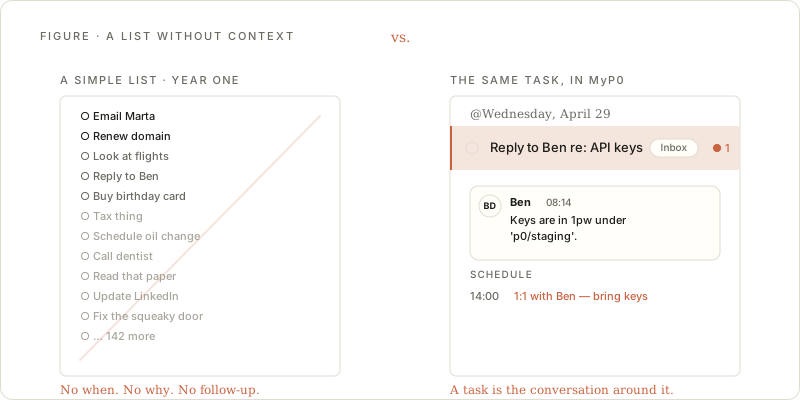
A todo item is typically a short phrase: “Follow up with Sarah,” “Review budget,” “Plan Q2 goals.” These made perfect sense when you wrote them. Two days later, they’re cryptic.
Follow up with Sarah about what? Which budget — the one from the meeting or the revised version? What aspects of Q2 need planning?
The context that surrounded the task when you created it evaporates, and you spend the first chunk of every work session reconstructing what you meant. Sometimes you skip the task entirely because you can’t remember why it mattered. This is wasted cognitive effort that a smarter system would preserve for you.
No feedback loop
Simple todo lists are static. They don’t tell you anything about your patterns. They can’t show you that you consistently overestimate what you can do in a day, that you always push certain types of work to next week, or that your most productive hours are being consumed by low-value tasks.
Without feedback, you can’t improve. You just repeat the same cycle: make ambitious list, complete some items, roll the rest forward, feel vaguely guilty, start a new list.
What actually works
The research on productivity consistently points to a few principles that go beyond simple lists:
Time blocking. Tasks need to be connected to specific time slots. When you decide “I’ll work on the proposal from 2-4pm Tuesday,” you’ve transformed an abstract intention into a concrete commitment. This is the bridge between planning and doing.
Contextual information. Tasks should carry the context they need. The notes from the meeting where the task was raised, the relevant documents, the conversation that sparked it — all of this should be accessible from the task itself, not scattered across different tools.
Regular review. A weekly review where you process everything, update priorities, and plan the week ahead is what keeps any productivity system alive. Without it, lists decay into wish lists.
Fewer items, more depth. A short list of three things you’ll actually do today beats a long list of twenty things you might get to. Constraints force prioritization.
The system, not the list
The failure of simple todo lists isn’t really about lists at all. It’s about trying to solve a systems problem with a single tool. Productivity requires coordination between what you know (notes and context), what you need to do (tasks), and when you’ll do it (calendar). A list only addresses one of these.
This is why people who successfully manage their work tend to have an integrated approach — even if it’s just a notebook with a particular structure, or a combination of tools they’ve learned to use together. The system matters more than any individual component.
The question isn’t “what’s the best todo app?” It’s “how do I connect my tasks to my time and my context?” Once you answer that, the specific tools become secondary.